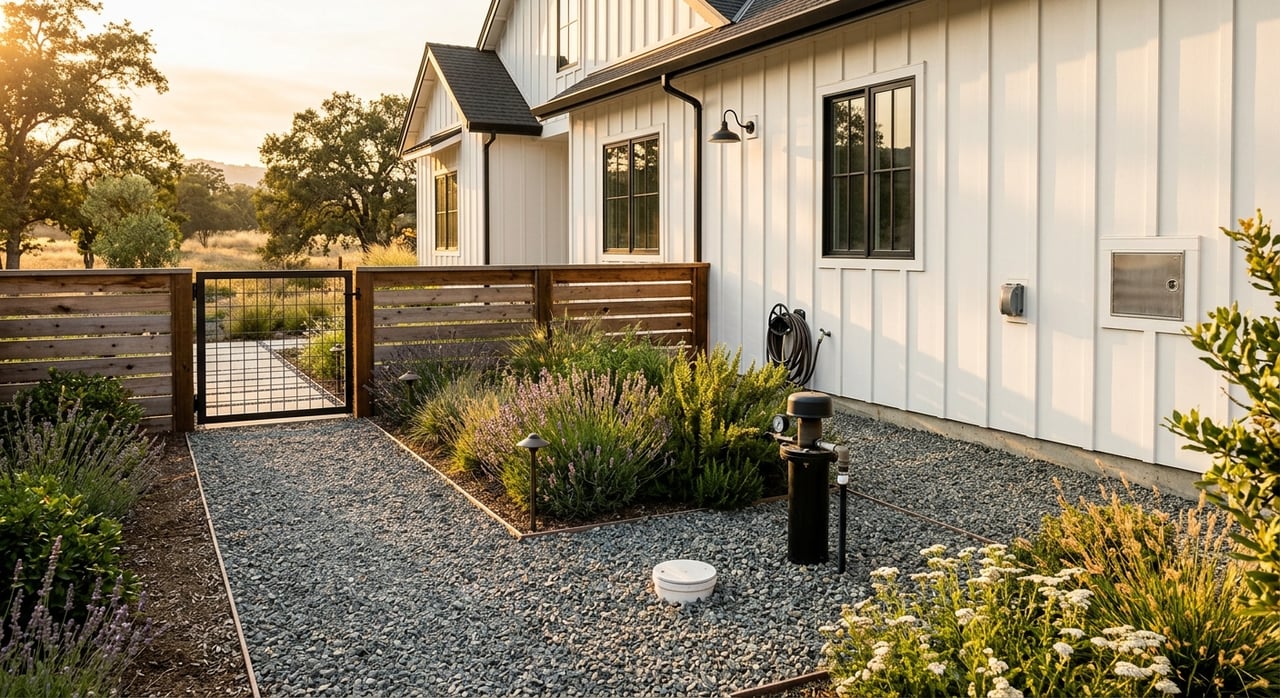
Wells, Septic And Fire Risk: Buying Rural Property Near Forestville
May 7, 2026
May 7, 2026
Buying a rural property near Forestville can feel like stepping into the West Sonoma County lifestyle you have been picturing for years. But with that charm often comes private infrastructure, site-specific rules, and wildfire considerations that deserve close attention before you write an offer. If you are looking at cabins, acreage, guest-house properties, or tucked-away country homes, this guide will help you focus on the issues that matter most. Let’s dive in.
Near Forestville, many properties rely on private wells, onsite wastewater treatment systems, and private access roads instead of municipal utilities. That changes the buying process in important ways because water, wastewater, access, and fire-readiness can directly affect use, cost, and future improvements.
Sonoma County reviews development tied to wells and septic systems through Permit Sonoma. County fire rules can also affect driveways, emergency water supply, road access, and vegetation management. In other words, these are not minor details to sort out later. They are central parts of the property itself.
If a property near Forestville has a private well, the owner is responsible for the drinking water. Sonoma County notes that private well water should be tested by a state-certified laboratory, and bacteria and nitrate are among the most common concerns.
A buyer should ask for the well report, age, depth, yield history, pump history, and any treatment equipment information. You should also review the most recent water test and confirm how that test was handled, especially if you expect it to support a real estate transaction.
Sonoma County’s well-water guidance says private well water should be tested by a state-certified lab. The county also notes that its own bacterial well-water test does not assess chemical quality and cannot be used for legal purposes or certain real estate transactions when the sample was not collected through a chain-of-custody process.
That means a water test result may not tell you everything you need to know. A clean bacteria result is helpful, but it does not replace broader chemical testing or the right collection method for your purchase file.
Before you move forward, ask questions like:
These questions can help you separate a well that is simply private from one that may require more immediate investigation or expense.
If you are buying with plans to build, expand, or add an ADU, well issues can become even more important. Permit Sonoma says water-well permits submitted after October 4, 2022 must meet water conservation and best-management requirements, and some wells must be metered and reported.
Permit Sonoma also says dry-weather well testing can be required for new or replacement dwellings in Class 4 areas and for ADUs in Class 3 or 4 areas. So if your vision includes more living space later, it is smart to ask early what standards may apply to that specific parcel.
Sonoma County’s 2025-2026 fee schedule lists examples such as:
Those are county permit costs only. They do not include drilling, pumps, storage, treatment, or hydrogeologic work, which can significantly affect your real budget.
A rural home near Forestville may have a standard septic system, a repaired system, or a non-standard system with supplemental treatment. Each comes with its own maintenance needs, review path, and potential replacement costs.
Permit Sonoma says septic review is required when a project connects to an OWTS, adds bedrooms or wastewater flow, or encroaches on the system’s capacity or replacement area. That matters if you are buying a property with plans to remodel, expand, or change how the home is used.
The county treats certain work as full replacement rather than minor repair. According to Permit Sonoma, replacement of the tank, replacement of more than 25 percent of the dispersal system, or replacement of a pretreatment unit falls into the replacement category.
That distinction matters because replacement work often means more planning, more review, and more cost. A quick seller comment like “the septic was worked on” does not tell you enough. You need records.
Permit Sonoma’s usual process for a new or replacement septic system includes:
For buyers, that sequence is important because it shows how much time and coordination may be involved if the system is failing or if your future plans trigger review.
Sonoma County gives rough examples for replacement-related costs:
Actual cost depends on factors like soils, slope, groundwater depth, bedroom count, creek setbacks, and other site constraints. The county also notes that owners are responsible for privately financing replacement or upgrade costs.
For 2025-2026, Sonoma County lists these example fees:
These figures help show why it is worth understanding the exact system type before you buy. A non-standard system may involve higher fees and more ongoing oversight than a simpler setup.
Some non-standard septic systems with supplemental treatment are placed in Sonoma County’s OPR monitoring program. That can include ongoing inspections and annual operational fees.
The county also notes that some systems may qualify later for a reduced annual-fee permit after a record of acceptable operation. For routine maintenance, Sonoma County says non-standard systems should have septic tanks pumped on average every 3 to 5 years.
In rural West Sonoma County, access is not just about convenience. It can affect emergency response, future permitting, and whether a property functions the way you expect.
Sonoma County assigns addresses in unincorporated areas and names roads that provide primary access to two or more residences or businesses. The county also says it maintains public roads, but not private roads. If the road serving the property is private, you should understand who maintains it and what documents are recorded.
County fire-safe standards set important limits for access. Sonoma County says road and driveway grade is limited to a maximum of 20 percent, and grades above 15 percent require County Fire Chief approval.
The county also says driveways longer than 150 feet need a turnout near the midpoint. Driveways longer than 800 feet need additional turnouts roughly every 400 feet. One-lane roadway bridges must provide at least 12 feet of unobstructed width and turnouts at both ends.
Sonoma County also warns that many existing driveway entrances do not meet current standards. That does not automatically mean a property cannot be purchased or used, but it does mean you should ask whether any known exceptions, upgrades, or fire review comments apply.
If a parcel is not served by public water, county fire guidance says a project may require fire-flow calculations and water storage under NFPA 1142. Sonoma County also notes that tanks over 5,000 gallons require county permitting.
Wildfire is part of rural property due diligence near Forestville, but it helps to use the right terms. CAL FIRE says Fire Hazard Severity Zone maps classify land as moderate, high, or very high hazard, and those maps evaluate hazard rather than risk.
That is an important distinction. Sonoma County’s 2025 update says the maps affect development standards and disclosure requirements, while CAL FIRE also says the maps do not determine insurance rates or availability.
Sonoma County says defensible space generally extends 100 feet from building walls or to the property line. County guidance describes a 30-foot lean, clean, green zone and a 30- to 100-foot reduced-fuels zone.
Requirements can vary based on whether the parcel is in a Local Responsibility Area, State Responsibility Area, or a municipal location. CAL FIRE also notes that local jurisdictions may impose stricter standards than the state minimums.
Before you write an offer on a rural property near Forestville, try to assemble a file that answers the biggest practical questions. This can save you from vague assumptions and help you understand both current condition and future use.
Ask for:
If you are planning to add a dwelling or ADU, ask early whether dry-weather well testing, metering, water-conservation compliance, fire-flow storage, or sprinkler requirements may apply.
The appeal of a rural Forestville property often lives in the very features that require the most careful review: privacy, acreage, independent systems, winding roads, and a stronger connection to the land. These homes can be deeply rewarding to own, but they ask for a more thoughtful buying process.
That is where local knowledge makes a difference. When you know which records to request, which county departments shape the file, and which site features deserve extra attention, you can move with more clarity and fewer surprises.
If you are considering a cabin, country home, or acreage property near Forestville, a calm, thorough review can help you match the romance of the setting with the realities of ownership. For personalized guidance on rural property due diligence in West Sonoma County, connect with The Hedges • Davis Group.


If you're seeking a real estate professional who combines unparalleled dedication, market expertise, and genuine kindness, The Hedges • Davis Group is a perfect choice.

Timothy Hedges | CA DRE# 01368460
[email protected]
(707) 696-7325
6790 McKinley St #120
Sebastopol CA 95472